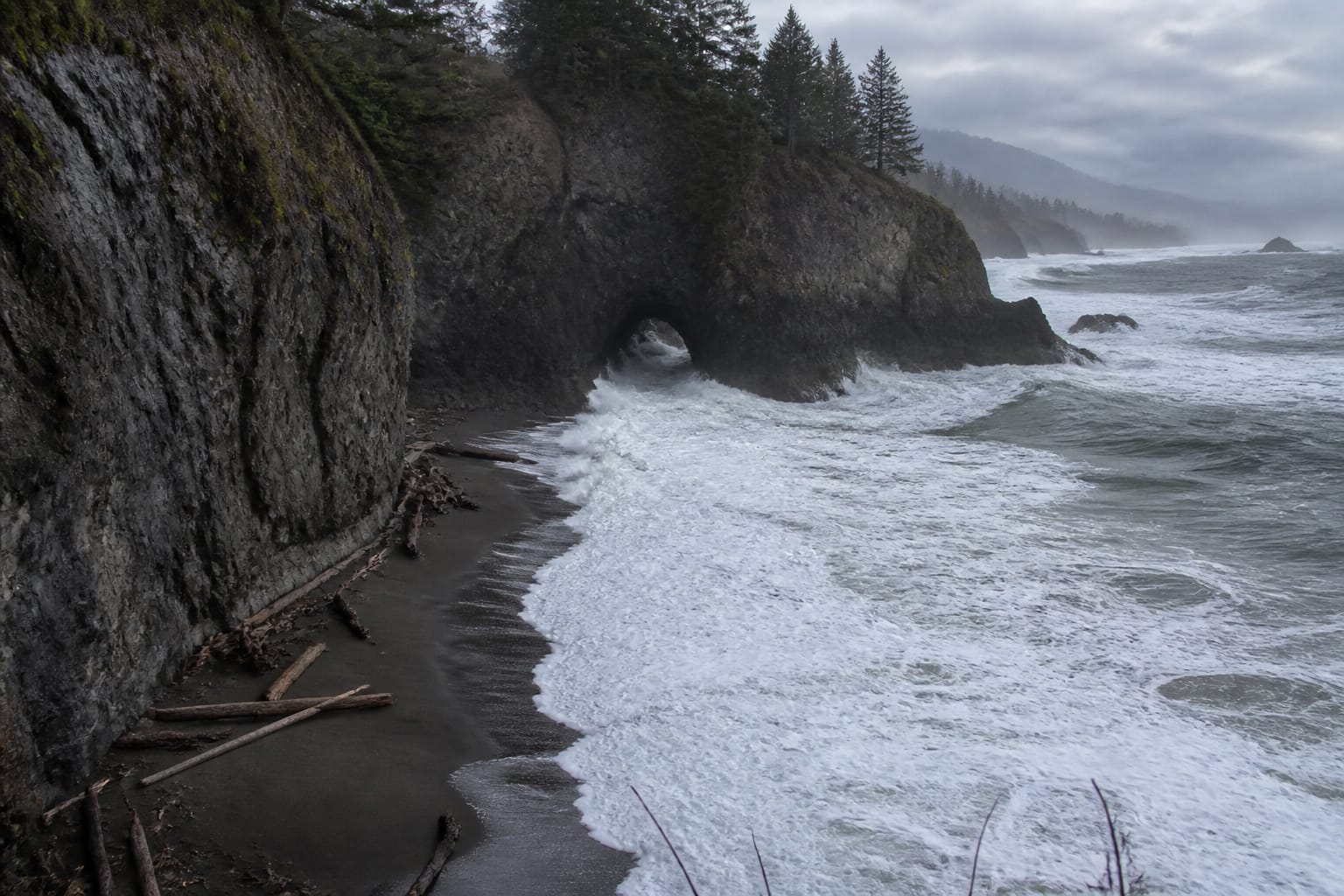
The sand went first. Not all at once — in increments, each wave reaching a little further up the cove, each retreat leaving less beach than the one before. Three visitors in their twenties stood on what was left of it, backs to a cliff on the north Oregon coast, watching the way they had come in disappear under white water.
There is no safe way out of Lost Boy Beach on foot. The cove sits just north of the village of Oceanside, past the north end of Tunnel Beach and the headland that holds Lost Boy Cave, and the only approach is a scramble over rocky ground and a walk through a sea cave that is open at both ends — passable only during rare extreme low tides, a couple of times a year. When the water comes back in, the cave is ocean. The cliff behind the beach offered no safe route out.
They had come down for a photograph, something dramatic, the kind of seascape this coast is known for. Now the waves that afternoon were large, the wind was gusting, the temperature was falling, and the three were wet and cold. At the base of the cliff, normal cell service was gone. One of them used an emergency satellite SOS feature to reach 911.
The alert got through. It was the afternoon of Wednesday, September 16, 2026. The message reached the Tillamook County Emergency Communications District, and from there the Netarts-Oceanside Fire District, a department run by volunteers, with U.S. Coast Guard Station Tillamook Bay assisting.
Crews launched a drone. Fire Chief Jeff McBrayer later said it found the trapped group in minutes, and the images it brought back are the ones that traveled: three small figures on a strip of sand between the cliff and the surf, and beside them, laid out on the beach, the beginnings of an enormous distress signal. They had been dragging driftwood into position to spell SOS. The earliest local account, published the following morning, describes them as having begun constructing it — the letters possibly still unfinished when the drone passed overhead.
Knowing where they were did not solve the problem of reaching them. Lost Boy Beach is said to take its name from a local legend roughly a century old, about a boy believed to have drowned after the incoming tide trapped him. The story has never been verified. The geography that produced it is real enough. Neighboring Short Beach got a community-built stairway of a hundred steps around 2000; Lost Boy never got safe access of any kind.
Crews considered waiting for the tide to recede. But the surf that afternoon was heavy, with the risk of sneaker waves — the sudden, outsized surges that arrive without warning. The three were already wet and cold, the wind was gusting, and the temperature was falling. Hypothermia was a real concern. Waiting meant leaving them where they were, cooling, with the water still coming. The crews chose to go and get them.
So the rescue went in along the edge. Rather than wading directly into unpredictable water, the team hugged what remained of the shoreline, secured to ropes, and hoisted a rescue line around a hazardous point while the waves kept coming in. The isolation that made the cove worth photographing made the rescue itself inherently risky.
Then the shoreline ran out. The team reached a rock face and stopped. "That team made their way to a rock face, and we had to wait a little while, about 40 minutes, for the wave action to recede, because we were having large waves that afternoon," McBrayer said.
The window came. "Once our team was able to safely make it around the rock face, we tethered those folks with life vests and got them back to safety," McBrayer said. The three were fitted with life vests, clipped to the safety lines, and guided through the surf to a secure area, from which they were able to walk out on their own. They had been stranded roughly five hours. Fire district photographs taken afterward show crews with them, and the rescued group in the back of a department pickup.
All three came out with only minor bumps and bruises. No one was killed, no one was missing, and no outlet reported anyone taken to a hospital. The fire district's own public post did not give their names. It called them what they were: "3 visitors became stranded on Lost Boy Beach." None of the three has been interviewed.
What officials wanted to talk about afterward was the next group. Viral posts, they said, are steering visitors toward coves like this one, and conditions there can change in minutes. Both visitors and locals, they said, need to watch the tides.
McBrayer's advice was simpler. "You have to ask a local or check a tide app on a phone for tide information," he told The Oregonian. And about Lost Boy Beach in particular: "When people are stranded there, we may not be able to get to them."
Keep reading, free.
The rest of this story is part of the free Trapped Alive newsletter. Sign up and it unlocks right here — no payment, ever.
No spam. Just real stories.