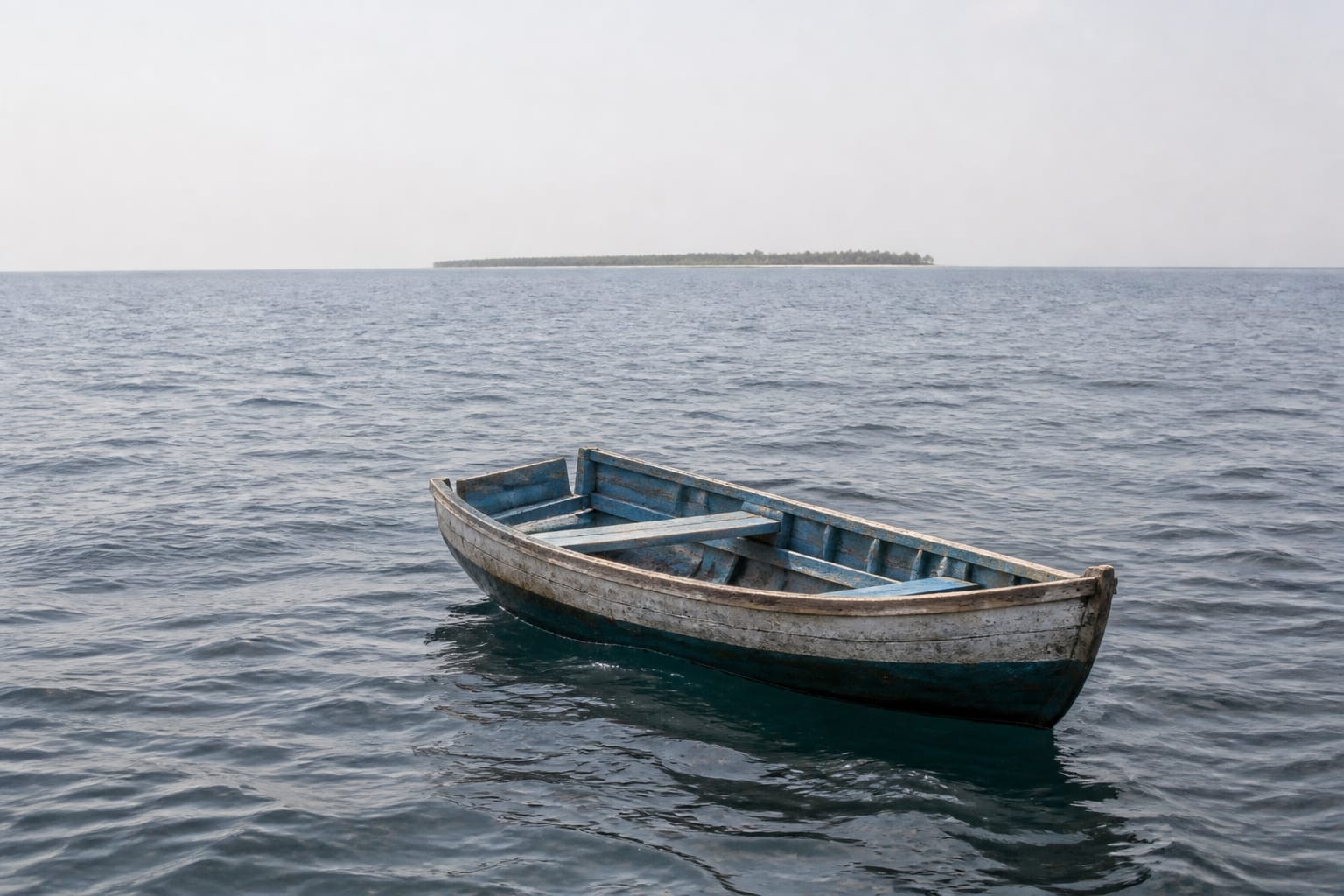
By the time it was found, the boat had drifted for 41 days. Its motor had developed problems. There was no anchor on board. Without power or an anchor, it could only drift.
Luka Rahan was eighteen years old. In September he set out from northern Bougainville, in the Autonomous Region of Bougainville, Papua New Guinea, with his cousin, to fish. Somewhere out on the water the motor stopped being reliable. That is the whole of what has been reported about how it began: two men, a fishing trip, a motor giving trouble, and nothing aboard to hold the hull in place.
No distress call, radio message, beacon or search has been reported. After that, there is little public record of what happened to them. The next confirmed moment comes 41 days later, on a Tuesday afternoon in late October, about 2,000 kilometres from where the boat had started, in the water between the Kiribati atolls of Tarawa and Maiana. A group of Kiribati fishermen came across the drifting boat there. Only one of the two men was still aboard.
What happened inside those 41 days has mostly not been told. No first-person account from Rahan was available in the sources used for this story. The one hard fact about his condition is that when he was found he was severely dehydrated. What he drank, what he ate, whether it rained, whether he had fuel or a paddle or any way to catch water, whether a ship or an aircraft ever passed within sight — none of that has been reported. What remains is the known duration: 41 days.
Northern Bougainville sits at the western edge of the Pacific. Tarawa and Maiana are low coral atolls in Kiribati, close to the equator, roughly 2,000 kilometres to the east. No route and no current has been reported for the drift. What is reported is the distance between the place the boat set out from and the place it was found, and the time that passed in between.
Somewhere in the last week or so of that time, Rahan's cousin died at sea. His name has not been published, nor his age. The two available accounts do not agree: the ABC reported that it understood the cousin died at sea the week before the rescue, a hedged attribution rather than an on-record confirmation, while an ABC radio segment the same day said he was lost overboard earlier in that week. No official confirmation has been located. After that, Rahan was alone in the boat.
On the afternoon of Tuesday 27 October 2026, a group of Kiribati fishermen working the water between Tarawa and Maiana came across a boat far from where it had set out. How many of them there were has not been reported, nor their names, nor what was said, nor how they got him out of his boat and into theirs. What is known is that he was alone in it, severely dehydrated, and alive. They brought him in to Tarawa, Kiribati's capital, where he was admitted to hospital.
Jonathan Anthony Kunau, a Papua New Guinean engineer who lives and works in Tarawa, heard about the rescue and went to the hospital. He had no part in finding Rahan. He went because of where the young man was from.
"He's from my country, he's my countryman," he said.
The visit turned out to matter in practical ways. Kunau helped translate between Rahan and the Kiribati authorities and the healthcare workers treating him, so that an eighteen-year-old recovering from severe dehydration in a foreign hospital had someone who could help him communicate. Kunau described him as responsive and working to regain his strength.
"It's just moral support," Kunau said. "He needs to get well soon."
Kunau also contacted Rahan's immediate family in Bougainville and told them he was alive and in hospital in Tarawa. They were, he said, grateful to hear it.
It was the second long-distance rescue involving Bougainvilleans in Kiribati in about a month, though the two cases are unconnected — different people, different routes. Three men from Nissan Island, Darrell Tokiapron, his brother Mitchell and Horen Kapiatu, ran out of fuel on 21 July on a run of about 94 kilometres to Buka and tried to use the wind to reach Tuvalu or Hawaii; after more than two months at sea they made landfall far to the east at Kiritimati, were looked after by Kiribati officials, and flew into Port Moresby on 26 October, the day before the fishermen found Rahan. "We drank salt water to survive," Tokiapron said.
As of 28 October, Rahan was still recovering in hospital in Tarawa. Nothing further has been reported about when he went home, or about his cousin's body.
Kunau, the engineer, offered fishermen one piece of advice, and set against the facts of Rahan's case — a motor that gave trouble, no anchor aboard, no reported way to call for help — it was not abstract. Carry a compass. Carry an anchor. Carry a phone.
Keep reading, free.
The rest of this story is part of the free Trapped Alive newsletter. Sign up and it unlocks right here — no payment, ever.
No spam. Just real stories.