When the flood reached the tunnel, Lu Haitao went up. He later recalled climbing to a high point inside the adit — a side passage driven into the wall of a Himalayan valley — and staying there, and that this was why he survived. After that there was nothing to see. No daylight reaches that far inside a mountain.
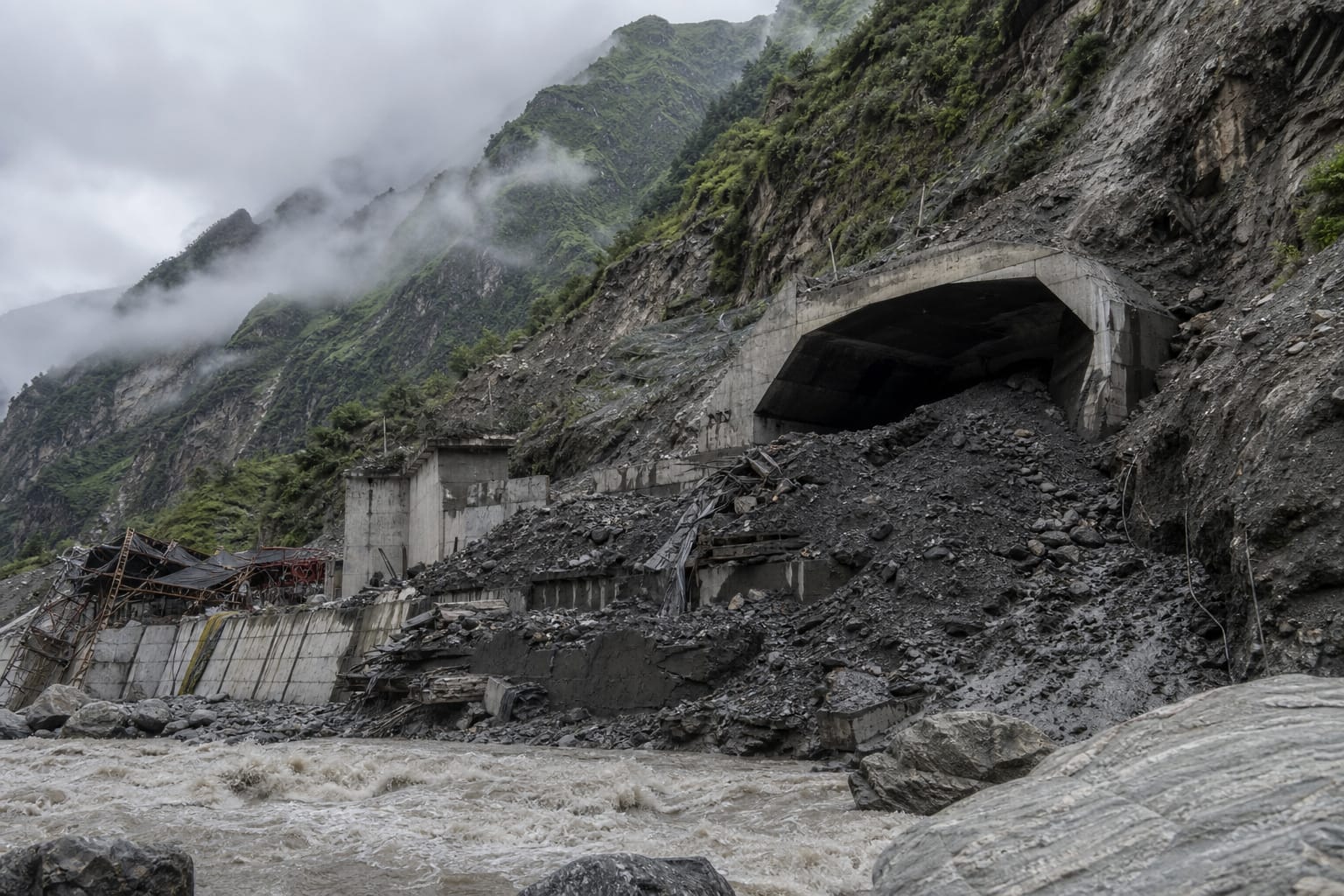
The water had come off a glacier. On Wednesday 26 August 2026, high on the border between Nepal and Tibet, a glacier collapsed and sent a torrent of water, rock, ice and mud down the Bhotekoshi and Trishuli river valleys. Downstream, in Rasuwa district north of Kathmandu, it inundated the 216-megawatt Upper Trishuli-1 hydropower project, a scheme being built by a South Korean company, its tunnels bored into the valley wall. More than 1,400 people were working there. One of them was Lu, 49, a farmer and carpenter from Henan province who had come to Nepal in February for what was reported to be his first job abroad. He was inside Adit 4.
Over the days that followed he saw torchlight in the distance, again and again — search parties somewhere out in the dark ahead of him. Each time, he shouted as loudly as he could. No one heard him.
He heard whistles too, blown by search parties, and assumed his mind was playing tricks on him. The rescuers' shouts never reached him at all, he told Chinese Embassy staff afterwards. What he could answer was the light. "Every time I saw the rescuers' lights in the distance, I shouted as loudly as I could," he told the Chinese state broadcaster CCTV.
Outside, the scale of the disaster was still becoming clear. By 5 September, Nepal's national disaster authority counted at least 1,331 dead and about 5,000 missing, among them 589 foreign nationals; across the border in Tibet, 31 dead and 531 missing. Roughly 900 hydropower workers were unaccounted for, about 500 of them believed to be still inside tunnels at a dozen projects. Earlier reporting on 3 and 4 September put the damage at 387.5 billion Nepalese rupees, about $2.5 billion, and a national day of mourning was set for 7 September.
Search teams came from India, China, South Korea and the United States, along with a fifteen-member Australian drone unit. At Upper Trishuli-1, the Nepali Army worked alongside the Korea Disaster Relief Team — deployed chiefly to look for nine missing South Korean workers — and alongside Chinese tunnel-rescue specialists. The Korean team began full-scale operations on Thursday 3 September. The nine Koreans were still missing.
Other workers were found alive that week. On 3 and 4 September, after more than seventy-two hours of digging, two men were brought out of the tunnel of the 60-megawatt Upper Trishuli 3A project nearby: Nepal Electricity Authority mechanical foreman Sanjay Sah, after nine days, and Kabir Maharjan on the tenth. Both were about forty metres in. Sah, who had been in the control room, told army personnel: "I was the last to leave because I had been helping others escape after the accident, and ultimately could not get out myself." He believed forty to forty-five people may have been inside.
At Upper Trishuli-1 the teams pushed deeper. On Saturday 5 September, at around 1:20 in the afternoon, searchers reached a point some 225 metres inside Adit 4 and their lights fell on Lu, still alive. It was the eleventh day of the search operation. He had been underground for ten full days.
"When they rescued me today, when they shone (the light) before my eyes, I couldn't believe it," he said afterwards, in audio broadcast by CCTV of him speaking to an officer.
A photograph released by the broadcaster shows two rescuers carrying him out of the tunnel. Nepali Army spokesperson Rajaram Basnet confirmed the rescue and the assistance of the foreign specialists, and Nepal's Prime Minister's Office announced it on social media. South Korea's SBS described Lu as emaciated but without visible major injuries; Red Star News reported that his pulse and breathing were stable after first aid on site. He was mildly hypothermic. He was taken to the Nepali Army's Maithili barracks at Trishuli in Nuwakot for a medical check and was later treated at the Military Hospital in Chhauni, Kathmandu. Al Jazeera reported that he was flown to Kathmandu by helicopter.
Hours later and further down the valley, at Betrawati in Nuwakot, a nine-member police team led by Assistant Superintendent Suman Kumar BK found 64-year-old Chandika Shrestha alive on the upper floor of a four-storey house the flood had buried. They gave her water and airlifted her to Kathmandu. "We are waiting for the rescue of more and more people," Nepal's information and communications minister, Bikram Timilsina, said that day.
China's ambassador to Nepal, Zhang Maoming, whose country had sent tunnel-rescue experts and forensic specialists to the operation, called Lu's rescue a miracle and said, in remarks reported in Chinese, that it strengthened the resolve to keep searching.
By 23 September the figures from the hydropower sites were still grim. Energy Minister Biraj Bhakta Shrestha told the House of Representatives: "According to the information we have received, more than 800 people working at various hydropower projects and structures are still unaccounted for." At Upper Trishuli-1 alone, 439 of the 1,433 people working before the flood remained missing, and 39 bodies had been recovered from the project's tunnel.
Lu had never told his family exactly where in Nepal he was working. According to Nepal News, they were notified that he was missing only six days after the flood. His sister, Lu Hairong, learned by telephone that he had been found; the family said they could not believe he was alive until the photographs appeared in the news. In mid-September, Chinese local media reported that he would be home in Henan before the Mid-Autumn Festival. "It's a stroke of sheer luck amid the misfortune," his sister told Cover News.
Keep reading, free.
The rest of this story is part of the free Trapped Alive newsletter. Sign up and it unlocks right here — no payment, ever.
No spam. Just real stories.