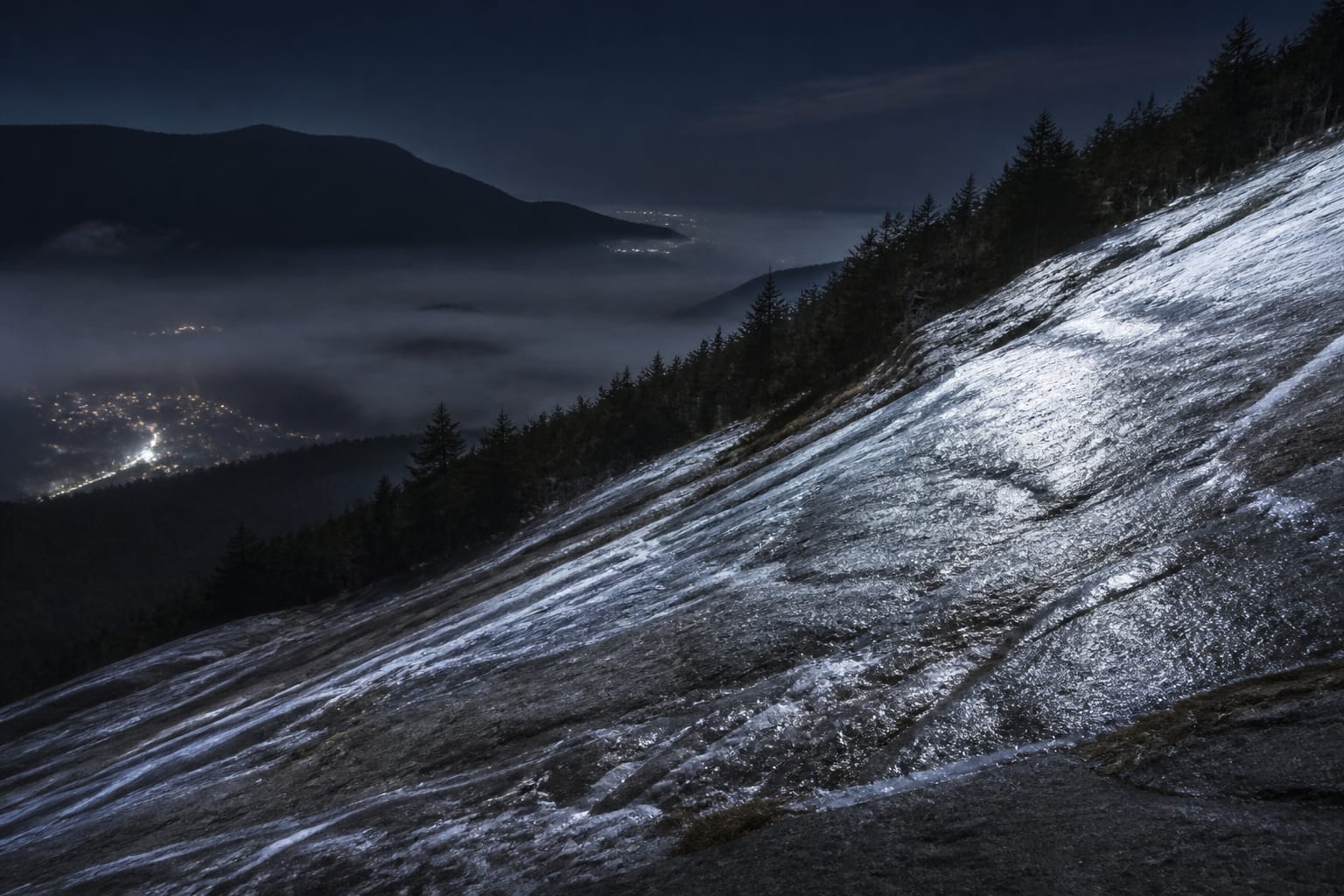
The trees were about seven feet away. Branches, handholds, a way off the open rock — seven feet of ice-glazed slab between him and all of it. To reach them he would have to jump. Below him the slide ran down to cliffs, and he judged that a missed jump, or a slip while he stood there, would almost certainly kill him.
So he stayed where he was: a patch of rock roughly one foot deep and three feet long, not a true ledge, just a place where the mountain tilted a little less steeply than everything around it. There was no room to sit down. It was Wednesday, October 21, 2026, on the Trap Dike on Mount Colden, in the Adirondack High Peaks above the town of Keene. The sun was gone, the temperature was falling, and the rock had iced over. Rangers call the route a fourth-class climb; several people have died on it over the years. According to WCAX, the 60-year-old Canadian climber standing on that scrap of stone had lost his crampons on an icy ledge, and the loss left him stranded.
At 6:22 p.m., dispatchers at the state Department of Environmental Conservation office in Ray Brook received a satellite beacon SOS. It was only a signal and a set of coordinates — no call, no text, no explanation. Someone on the edge of the slide had pressed the button.
He did not jump.
Instead, the climber — identified by the Adirondack Daily Enterprise as Eric Le Bourhis, 60 — did the only things the perch allowed. He pulled on extra layers. He turned his headlamp down to its lowest setting to stretch the battery, shrinking what he could see to a faint circle at his boots. Then he waited.
From where he stood, he could see the lights of Lake Placid, miles to the north and thousands of feet below him: a scatter of warm points in a black valley, as far out of reach as anything he had ever looked at.
The hours went by. His legs began to go wobbly under him. Cramps seized them, more than once. There was no room to sit, no safe way off the slick incline. He had no reply and no confirmation that anyone was coming.
Down in Ray Brook, the difficulty was the nature of the alert itself. Because it was an SOS signal only — not a phone call, not a text — few details were known. The rangers had a location. They did not have a situation.
At least four DEC forest rangers started up Mount Colden that night. Forest Ranger Nathan Jeffrey later said in a DEC interview that the team did not know the nature of the emergency, how many people were involved, or whether they would need ropes. Because the signal came from the edge of the slide, they had hoped it might be something simpler: a hiker who had run out of daylight in the trees.
Jeffrey had been out the night before, too, part of a crew that rescued four lost hikers on Mount Marcy. It was that kind of stretch in the High Peaks. They climbed Mount Colden in the dark with little more than coordinates.
It was around 1 a.m. when they reached him. By then he had been standing in the same spot for nearly seven hours.
Getting to a person stranded on iced rock is its own problem. Forest Ranger Jenna Curcio moved out across the ice to him, and for a moment the danger belonged to both of them at once — two people on the same frozen slab, one of them not yet clipped to her tether.
"When I got out to him and was trying just to get him secured to me, the thought went through my mind: if we both slip before I have him clipped in and on my tether, he's dead," Curcio said. "He's like, gone."
Once she clipped him to her tether, the worst moment had passed. Rangers brought him off the mountain.
No injury was reported in any account, and no hospitalization was mentioned. After most of a night on a sloping foot of ice, he survived without any reported injury.
Afterward, rangers emphasized the basics: research the route, understand what it demands, and prepare for the conditions. In late October, ice can glaze the rock on the Trap Dike, and darkness comes early.
What stays with you is the calculation he made up there — seven feet to the trees, one jump, cliffs below — and what he did with it. He added the clothing he had, dimmed his light to make it last, and stood on a patch of rock a foot deep and three feet long until the headlamps came up the slide toward him, the lights of Lake Placid still burning thousands of feet below.
Keep reading, free.
The rest of this story is part of the free Trapped Alive newsletter. Sign up and it unlocks right here — no payment, ever.
No spam. Just real stories.