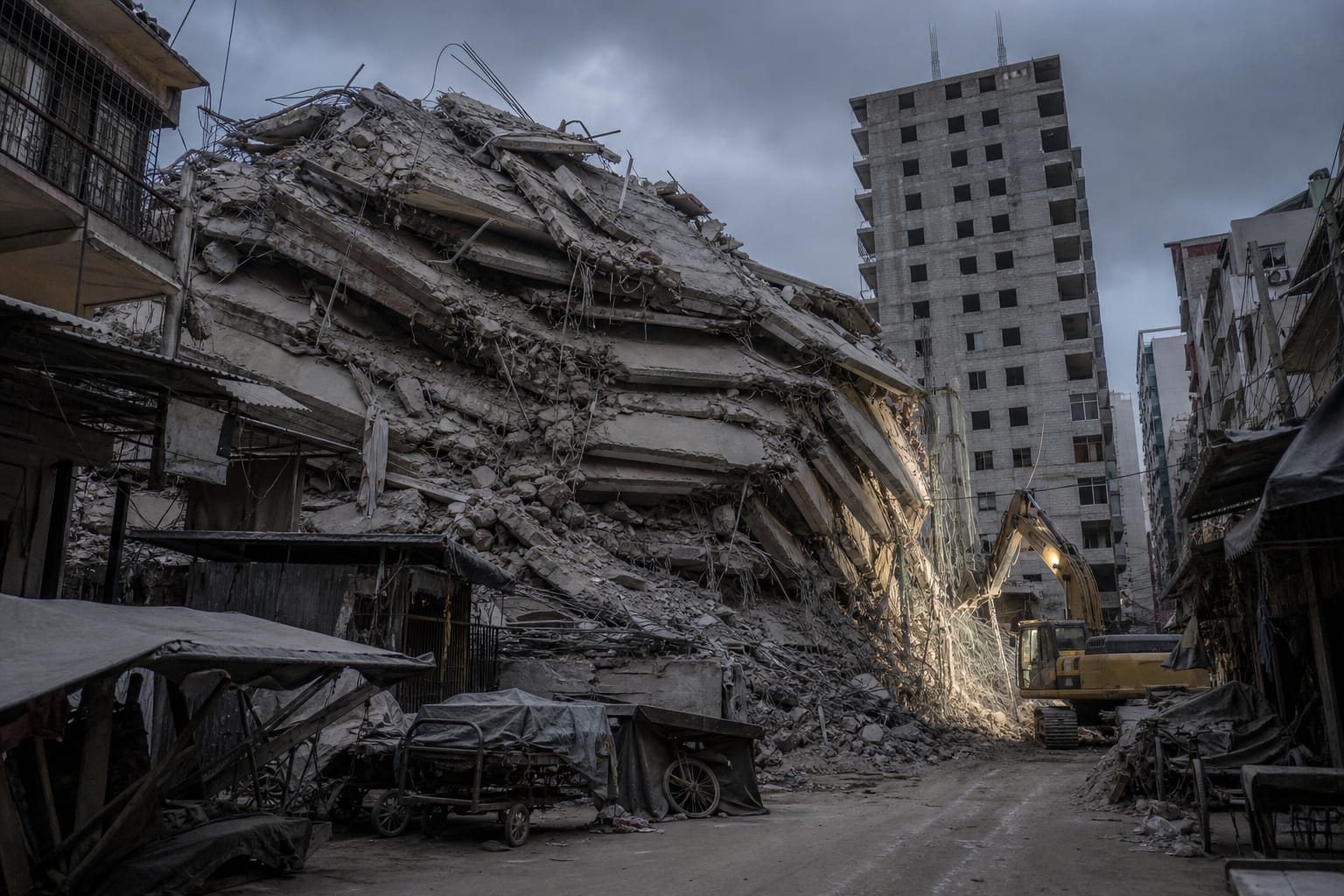
Zainab Mohammed heard the noise first and misread it. Shortly before the building above her shop collapsed, she later said, there were loud sounds outside, and she took them for people quarrelling. It was a reasonable guess. This was 9th Street in Eastleigh, a dense commercial neighbourhood east of Nairobi's centre, on a Friday afternoon in late October.
Nearby, in a basement tailor's shop on the same street, Victor Onyango was at work. Above the shops stood an unfinished high-rise — eighteen storeys by most accounts, though published descriptions of its height varied from ten to eighteen. It had no occupation certificate. The ground floor and basement were in commercial use anyway. Eleven shops on the ground floor and in the basement were occupied at the time, Interior Cabinet Secretary Kipchumba Murkomen would later say.
At about one o'clock the structure failed. It collapsed, burying the shops below and leaning against the building next door hard enough that Nairobi's police chief, Issa Mohamud, would warn that the neighbour might go too. Zainab's husband, Sultan Mohamed, had just left the shop for Friday prayers at a nearby mosque. He came back to a mound of broken slab where the family's livelihood had been standing, to a crowd, and to no way of knowing whether anyone inside was alive.
Under the wreckage, Zainab could not move. She was in a cavity barely bigger than she was, wedged into a gap between two refrigerators. "All sides were blocked by stones," she said afterwards, speaking in Swahili. "Above me were stones, and on the sides were stones. There was nowhere to get out." She had water. She prayed. A fridge, she later told K24 Digital, was part of what kept her alive.
Onyango was in a dark pocket of stone, broken concrete and twisted fittings, the structure still settling around him. He began to work his way upward, slowly, climbing over stones and broken slab, feeling for what he could not see. For hours he was stuck beside a pillar. At some point he found a fridge in the debris with soda and water inside, and rationed what he took, drinking the soda and using the water to cool himself.
Then he heard a woman crying somewhere in the ruin, and called out to her.
They could not see each other. They were in separate pockets of the same collapse, divided by whatever the building had left between them. But they could hear each other, and so they talked. Onyango knew the shops down there; he knew there was another large fridge close to where her voice was coming from, and told her to feel around for it. Through the hours that followed they kept talking. They gave each other strength, both would later say.
Above them, Eastleigh filled with machinery and uniforms: the Kenya Defence Forces, the National Police Service, the National Disaster Management Unit, the National Youth Service, Nairobi City County and the Kenya Red Cross. Excavators worked through the slab. The Red Cross set up a tent and a family tracing desk at the scene and publicised its toll-free line, 1199, for relatives trying to find people. Governor Johnson Sakaja said teams were working from the top of the collapsed structure down toward the basement. "We're asking Kenyans to keep praying for those trapped," he said.
The numbers kept changing. On Friday evening Murkomen said all 67 construction workers were accounted for — 66 unharmed, one hospitalised in stable condition — and that seven people were missing. By Saturday the Red Cross had taken 31 missing-person reports. By Monday, 47.
Onyango saw a small light. It told him rescuers were close. He was the first person taken out alive, after the best part of a day and a night underground; the Kenya Red Cross confirmed the rescue, and he was taken to Kenyatta National Hospital. He had not forgotten the voice. "When I saw the light and was rescued, I told them that my partner was still down there," he said.
Zainab came out on Saturday evening, more than 30 hours after the collapse, and was taken to Kenyatta National Hospital by Emergency Medical Services Kenya. The Eastleigh Voice reported that she was rescued unharmed. She has kept the dress she was wearing.
Her husband had waited at the edge of the debris for most of those 30 hours, not knowing. He did not eat. "I was not eating, a Somali lady was giving me water, and she supported me so much," he said. The strain pushed his blood pressure up and he had to seek medical attention. At one point, having waited in vain, he went back to the mosque to pray; when he returned a few hours later, Zainab had already been brought out.
The digging went on. On the third day, more than 50 hours in, nobody new had been pulled from the debris. Duncan Ochieng', the Kenya Red Cross deputy inspector for disaster management, said of those still buried: "Those still in the rubble if they are there. There are high chances they will be rescued within 72 hours." Bramwel Simiyu, Nairobi's chief officer for disaster management and coordination, said "teams are working tirelessly to ensure we are able to bring the matter to a close." Families stayed where they could see the machines. "Sisi tunahold kwa hopes kwamba watapatikana," said Robai Windo, a relative of one of the missing — roughly, we are holding on to hope that they will be found.
By the start of the following week, police said four people had been confirmed rescued alive and hospitalised. On 29 October, the seventh day of the search, rescue teams said about 80 per cent of the rubble had been cleared and were working toward the basement, where more people could still be trapped. Police opened a manhunt for the building's owner. Sakaja dismissed a circulating building-approval document for the site as fake.
Onyango lost the tailoring business that had supported him. Sultan and Zainab lost the shop that fed their three children. Near the pile where his wife had spent a day and a half, Sultan said: "What happened was a miracle, but we are waiting for more miracles by seeing our brothers and sisters who are still trapped also being brought out alive."
Keep reading, free.
The rest of this story is part of the free Trapped Alive newsletter. Sign up and it unlocks right here — no payment, ever.
No spam. Just real stories.