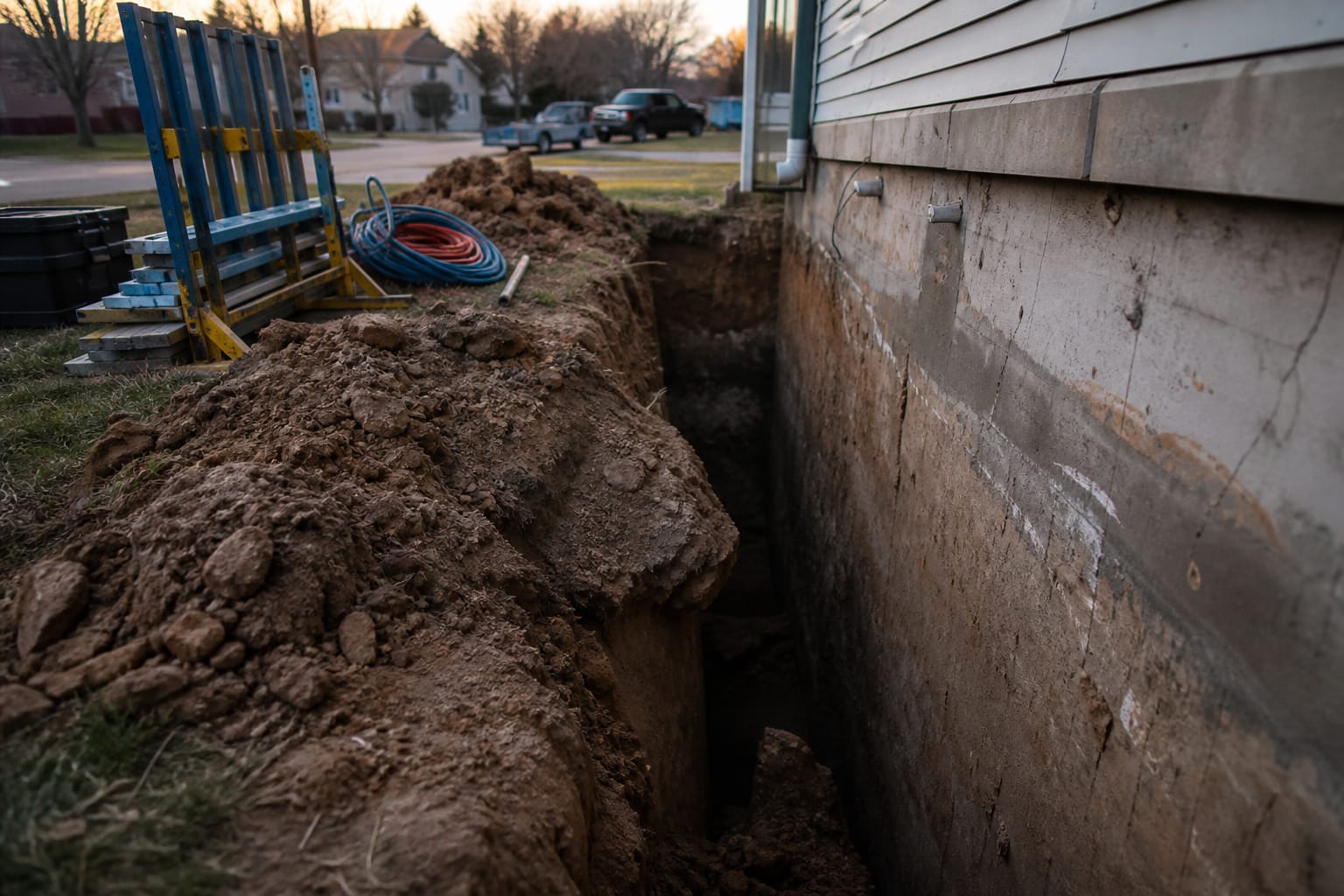
The trench cut into the ground beside the house in the 900 block of Ellis Street was about eight feet long, eight feet deep and only about two feet across — barely wider than a person's shoulders. A private contractor was working down there on the home's foundation on the afternoon of Monday, September 21, 2026, on a residential block in Liberty, Missouri, northeast of Kansas City. According to the homeowner's account, a wall gave way and trapped the worker in the trench.
The call went out at about 3:40 p.m. The Liberty Fire Department arrived first and asked the Kansas City Fire Department for mutual aid on the entrapment. Soon fire crews, KCFD rescue companies and City of Liberty utility crews were all working the scene, looking down into a gap narrower than the length of a shovel blade is long.
They could not tell where he was under the soil. "We couldn't tell where his arms and legs were," Ross Bartrom, the City of Liberty's manager of water services, said later. A single cubic yard of earth can weigh as much as 3,000 pounds, and this was ground that had already proved it would move. Anything done to reach the bottom of that trench had to be done without shifting it again.
The crews' central fear was a secondary collapse. KCFD Fire Rescue companies deployed specialized shoring equipment beside the excavation; photographs released afterward by the fire department show the gear staged on the grass along the trench line, an ordinary suburban lawn turned into a work site.
"Obviously you don't want to make a situation worse," KCFD Battalion Chief Riley Nolan said. "You don't want to create secondary collapses. You don't wanna shift the ground."
So the work went deliberately, and the pace was the point rather than a setback. "These type of situations are very long, very tedious, slow processes," Nolan said. Federal safety data make the case bleakly: most deaths in trench collapses happen in excavations less than ten feet deep, in holes that look survivable from the surface. OSHA requires protective systems in any trench deeper than five feet.
Somewhere in the fill was a man in what Nolan called a "pretty tight space." Where his arms and legs lay beneath the dirt, nobody could say — and that mattered, because every bit of soil taken out of a trench that narrow is soil that can pull more in behind it.
The turning point came from the City of Liberty Public Utilities Division. Bartrom directed his crews to bring in a hydro excavator, a truck that cuts soil with pressurized water and vacuums the slurry away up a hose. It is a tool built for exposing buried water mains without breaking them, precise enough to strip earth from around a person without anyone swinging a metal bucket in the trench.
His team had never done anything like it. "Never had done anything like that before," Bartrom said. "I was really nervous at the time."
It worked. "Able to get in, remove a lot of that dirt," Nolan said. "Really sped up the process." Of the utility crews, he said simply: "They assisted in a large way."
Daylight went out of the block while they worked. Roughly four hours after the 3:40 p.m. call, in the early evening, crews had cleared enough soil to bring the man up out of the trench alive.
Medics treated him at the scene and moved him to an awaiting ambulance for transport to a local hospital. In the hours immediately afterward, neither KCFD nor Liberty officials could say what injuries he had. KCTV5 reported the next day that workers at the Liberty home said he was doing okay and that he was recovering in the hospital; officials themselves released no further update on his condition. He has not been named.
Liberty Fire Chief Chris Young said OSHA had been contacted and would investigate, and that with the inquiry under way officials would not discuss the company involved, the work being performed or the specific circumstances of the collapse. No one has been accused of any wrongdoing. Young also stressed how much the department relies on mutual aid for complex incidents, and in its own statement KCFD called the operation "a great, coordinated effort involving multiple agencies and resources, including the City of Liberty Public Utilities, whose assistance was critical to the success of the operation."
Bartrom, who had started the afternoon nervous and had never run an operation like it, remembered the moment the man came out of the ground. "I just remember cheering," he said. "I just cheered as soon as it happened. I was just so happy to see him out safely."
Keep reading, free.
The rest of this story is part of the free Trapped Alive newsletter. Sign up and it unlocks right here — no payment, ever.
No spam. Just real stories.