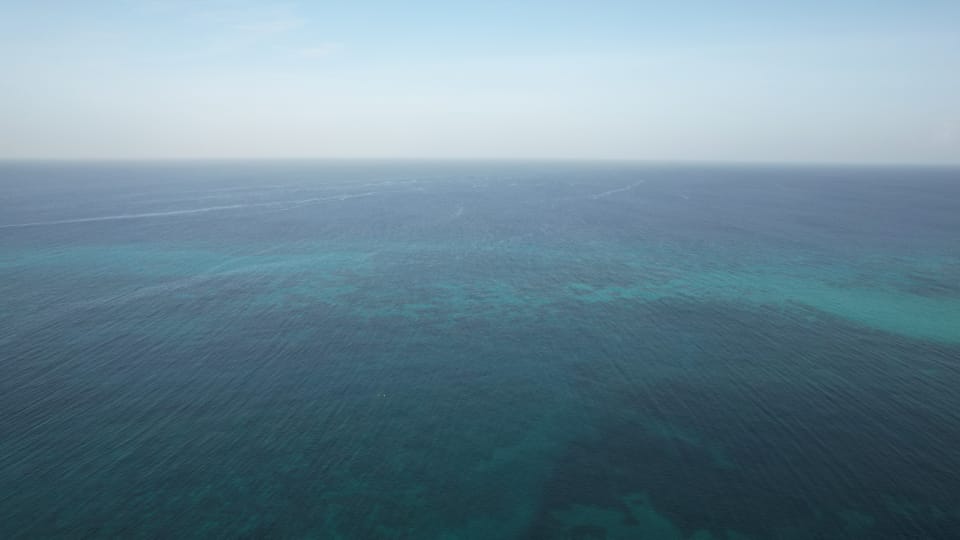
It was a beautiful day, by Jemma Cooper's account, and the sea was settling down. "I was on the helm, it was a beautiful day," she later told TVNZ Breakfast. "The sea state was settling down, and [we were] knocked sideways."
Terry Hetherington heard it before he understood it: a "very, very loud bang", loud enough to put him on his feet. "I jumped up, I grabbed the wheel, tried to turn the wheel," he said. "There was no movement." Jemma Cooper described the same instant — a huge hit, everyone in the cockpit thrown sideways, and then "there was just this wrenching sound, and then no control whatsoever at the helm, completely locked off".
The boat was the Tai Tam, a 51ft Australian-flagged yacht roughly 250 nautical miles north of Norfolk Island, about halfway through a passage from Fiji to the Bay of Islands. Jeremy Cooper had been resting in the starboard berth. He came up into a boat that no longer answered. Nearby, Hetherington saw what looked like four or five sperm whales in the water, though he never saw the animal they had struck. "I didn't see anything of the whale that was hit," he said. Below the waterline, the hull was open, and the South Pacific was coming in.
There were four of them aboard: the Coopers, who own the yacht and had sailed her from Australia to New Zealand around Easter; Hetherington, a New Zealander from Wanaka; and Martin Jaffray, a French crewman. They were on the last leg of a season — Bay of Islands to Fiji in early July, three months among the Fijian islands, and now the run back down to Opua. "We were really on our way to put it back into Opua," Jeremy Cooper said. "We were about halfway back, and then just out of the blue a massive collision with a whale."
For the first half hour nobody talked about abandoning anything. "We sort of spent the first half an hour just assessing the damage, trying to get the boat under control," Jeremy Cooper said. The other two went at the breach. "Our crew members, Martin and Terry, who are fantastic, you know, assessing damage, trying to stem flow, getting pumps going and just sort of buying as much time so we could make some decisions," Jemma Cooper said.
Time was the only thing the pumps could buy. The water was coming in faster than they could manage, and Jeremy Cooper said it became "pretty obvious the whole situation was unrecoverable". Mayday calls went out. The locator beacons were triggered. At around 1pm on Saturday 26 September, New Zealand time, the Rescue Coordination Centre New Zealand picked up the EPIRB alert — open ocean, 250 nautical miles north of Norfolk Island, with Opua still ahead.
The response reached them fast. "Within half an hour we were talking to New Zealand Rescue Services," Jeremy Cooper said.
At RCCNZ, Operations Manager Mike Clulow set the machinery going. "It was taking on water and began sinking after reporting it had struck a whale," he said of the yacht. "The yacht was experiencing seas of up to 2m, and a Royal New Zealand Airforce P-8A Poseidon was tasked with assisting. Several vessels were in the area and diverted to assist."
The Poseidon located the survivors and established two-way radio contact with them, then stayed overhead for hours. On the water, the four did the one thing that kept their options open longest: they stayed with the boat. "We wanted to keep the boat afloat for as long as possible to put off the time we had to get in the life raft," Jeremy Cooper said.
Eventually, they could not stay with the boat any longer. They abandoned the Tai Tam into the life raft and waited there overnight, the aircraft above them and a cargo ship making for their position.
The weather, at least, had come their way. Hetherington said conditions were calm by the time help arrived, and that "if it had happened 24 hours beforehand, the outcome could be significantly different".
The next morning the aircraft directed the ship in. The MV Sofrana Surville, a 143-metre cargo vessel and the first merchant ship on scene, came up on the raft and took all four off at around 6am on Sunday 27 September — roughly seventeen hours after the beacon alert reached RCCNZ. No injuries were reported.
The Tai Tam was abandoned and sinking. The four stayed aboard the Sofrana Surville, bound for the nearest port to disembark.
"The crew of the yacht did all the right things, and it was unfortunate to have struck a whale in open water," Clulow said. "They were well prepared and the early activation of their EPIRB was key to helping get them to safety. It is an excellent reminder that being prepared when going to sea can save your life." He thanked the New Zealand Defence Force, the Australian and New Caledonian rescue authorities, the Sofrana Surville and a private sailing vessel that had also assisted. "This was a well-coordinated and executed rescue," he said.
The species was never confirmed; officially, it was a whale. The Coopers remain convinced it was a pod of enormous sperm whales, and that the collision did catastrophic damage to the boat. Nothing has been reported about what became of the animal.
By Wednesday 30 September the crew were scattered again. The Coopers were home in Melbourne, talking to a television camera about a yacht lost in the South Pacific. "The whole thing was superbly executed," Jeremy Cooper said, "and so again, just we're super thankful to New Zealand for making it all happen." Hetherington was flying back to Otago that day. "I'm pretty tired," he said. "It's been a pretty hectic week, really."
The boat that had carried them from Fiji was gone. The four people who sailed her were ashore. Of the moment that decided it, Hetherington said: "It was a massive relief, stepping on board the container ship."
Keep reading, free.
The rest of this story is part of the free Trapped Alive newsletter. Sign up and it unlocks right here — no payment, ever.
No spam. Just real stories.